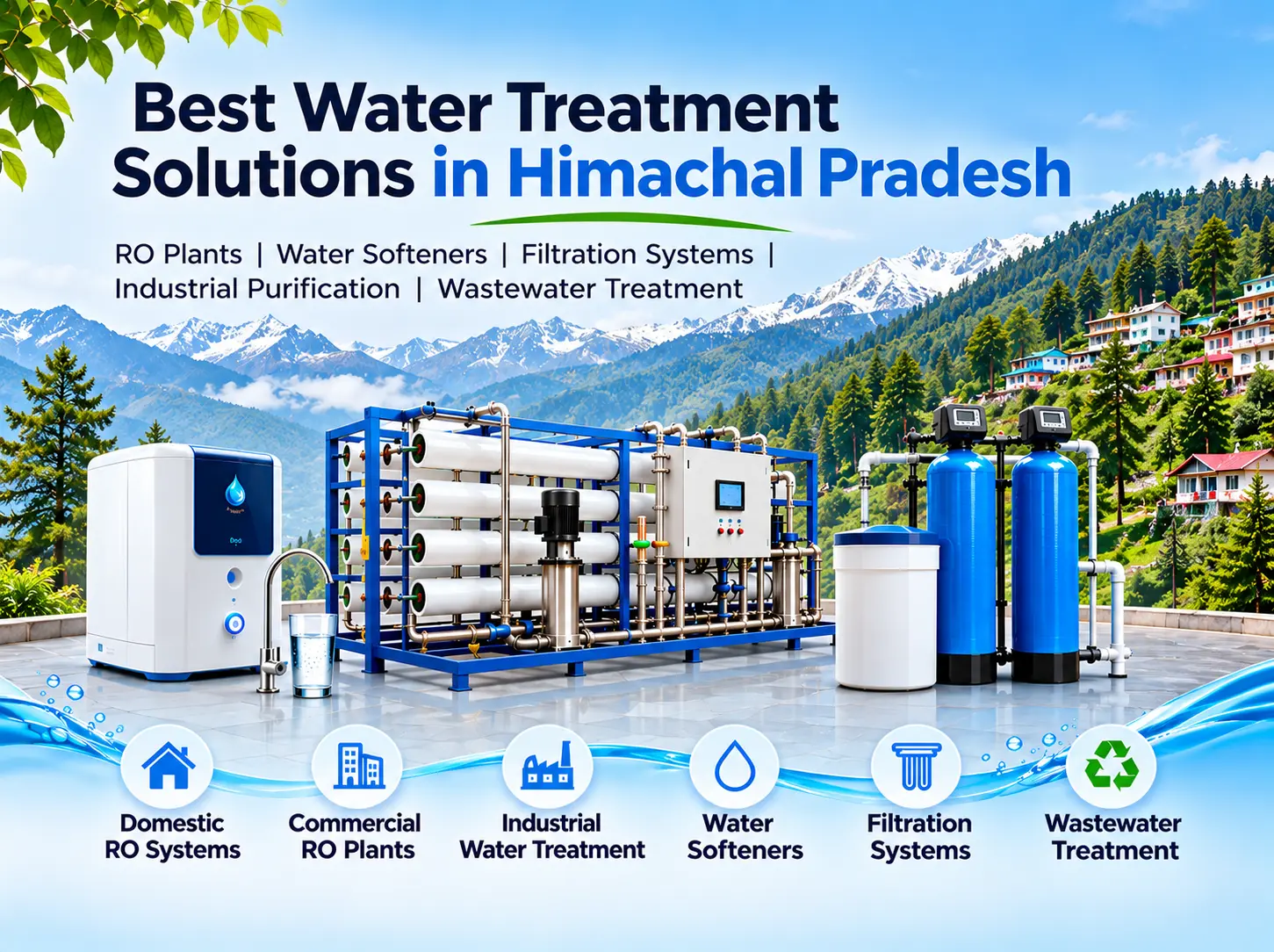
Understanding Himachal Pradesh's Unique Water Profile & Challenges
Himachal Pradesh is celebrated for its pristine snowcapped peaks and flowing rivers, yet its localized water chemistry is exceptionally diverse. Depending on whether your facility is located in an alpine tourist town or a fast-paced foothill industrial zone, raw water characteristics differ drastically—unlike the urban plains of Chandigarh and Panchkula:
- The Industrial Belt (Baddi, Barotiwala, Nalagarh, Kala Amb, Paonta Sahib, Una): Industrial units rely predominantly on deep industrial borewells. Groundwater in these foothill valleys frequently exhibits high Total Dissolved Solids (TDS between 500 to 1,200+ ppm), significant calcium-magnesium hardness, and silica content. Without proper treatment, this mineral load damages steam boilers, HVAC cooling towers, and delicate manufacturing lines.
- Hill Stations & Tourist Corridors (Shimla, Kasauli, Manali, Dharamshala, Kullu): Commercial hotels, luxury resorts, and homestays source water from municipal lift systems, mountain streams, or shallow natural springs (bawlis/chashmas). During monsoons and spring snowmelt, these sources suffer severe turbidity, high Total Suspended Solids (TSS), organic debris, and microbiological contamination like coliform bacteria.
- Sub-Zero Winter Temperatures: In high-altitude zones, ambient winter temperatures drop close to or below freezing. Cold water increases viscosity, causing a sharp drop in RO membrane permeability (flux) and risking freezing inside exposed pipelines and pressure vessels.
HPSPCB Environmental Compliance
The Himachal Pradesh State Pollution Control Board (HPSPCB) enforces stringent environmental guidelines to protect sensitive Himalayan ecology. Industrial units, manufacturing units, and commercial establishments with over 20 rooms must operate compliant Effluent Treatment Plants (ETP) or Sewage Treatment Plants (STP) to avoid severe penalties and closure notices, backed by certified industrial water treatment services.
Industrial Reverse Osmosis (RO) Plants for Baddi, Solan & Kala Amb
As the pharmaceutical capital of India, the Baddi-Barotiwala-Nalagarh (BBN) region produces a significant share of Asia's medicines, injectables, and consumables, working in close logistical synergy with manufacturing clusters in Mohali and the broader Tricity region. Water used in these facilities must meet pharmacopeial standards (IP, BP, USP) without variation.
At Shivam Water Treatment, we custom-engineer, assemble, and commission heavy-duty industrial RO plants ranging from 500 LPH to 50,000+ LPH designed specifically for the rigorous operating conditions of Himachal Pradesh:
1. High-Purity RO & Electrodeionization (EDI) Systems
Standard drinking water RO is insufficient for pharmaceutical manufacturing. We design two-pass RO systems paired with continuous Electrodeionization (EDI) polishing modules. Built entirely with SS316L sanitary piping, tri-clamp fittings, orbital welding, and continuous conductivity/TOC monitoring, these systems reliably produce purified water with conductivity < 1.3 µS/cm at 25°C, complying with strict USFDA and cGMP validation protocols using certified water treatment products and equipment.
2. Demineralization (DM) & Mixed Bed Plants
For chemical plants, textile dyeing units, metal finishing, and high-pressure steam boilers in Kala Amb and Paonta Sahib, our two-bed (Strong Acid Cation & Strong Base Anion) and Mixed Bed Demineralization (DM) plants strip mineral ions to near-zero levels. These heavy-gauge FRP and rubber-lined vessels withstand acidic and caustic regeneration, safeguarding expensive boilers from thermal scaling and corrosion.
3. Heavy-Duty Multi-Media Silt & Turbidity Pre-Filtration
Surface water drawn from mountain rivers or reservoirs carries erratic suspended particulates. We install multi-grade sand and carbon filters (sand + anthracite) with automatic backwashing heads to bring raw water turbidity below 1 NTU, ensuring downstream RO membranes remain free of fouling.
Technical Comparison of Water Treatment Systems in Himachal Pradesh
Choosing the right water treatment setup depends on your industry, raw water profile, and compliance needs. Conducting rigorous laboratory water quality testing is the essential first step before selecting from the primary systems outlined below:
| System Type | Standard Capacity | Target Contaminants | Ideal Sector / Application | Key Compliance / Standard |
|---|---|---|---|---|
| Industrial Two-Pass RO + EDI | 500 – 20,000 LPH | TDS, heavy metals, microbial pyrogens, dissolved ions | Pharma manufacturing, APIs, laboratories in Baddi & Solan | USP / IP Purified Water Standards |
| Demineralization (DM) Plants | 1,000 – 30,000 LPH | Mineral cations (Ca, Mg, Na) and anions (Cl, SO4, SiO2) | Boiler feed, battery manufacturing, chemical synthesis | IS 10496 / Conductivity < 2 µS/cm |
| Sewage Treatment Plants (MBBR / MBR) | 10 KLD – 500+ KLD | BOD, COD, TSS, fecal coliform, pathogenic microbes | Hotels, mountain resorts, universities, residential campuses | HPSPCB / CPCB Discharge Standards |
| Industrial ETP & ZLD Systems | 25 KLD – 1,000 KLD | Toxic effluents, heavy metals, industrial oils, chemicals | Packaging, textiles, FMCG, pharma effluent in Nalagarh & Una | Zero Liquid Discharge (ZLD) norms |
| Commercial Water Softeners | 500 – 15,000 LPH | Calcium & Magnesium hardness (scale buildup) | Hotels, laundry, HVAC chillers, commercial kitchens | Zero Hardness (< 5 ppm as CaCO3) |
Sewage Treatment (STP) & Effluent Treatment (ETP) Plants
Ecological stewardship is nowhere more vital than in Himachal Pradesh. Discharging untreated domestic or industrial wastewater into mountain valleys contaminates downhill aquifers and sensitive river systems.
1. Compact MBBR & MBR STP Systems for Hotels & Resorts
Hill station properties in Shimla, Manali, and Kasauli often operate on steep, restricted footprint plots. Shivam Water Treatment supplies compact, skid-mounted Moving Bed Biofilm Reactor (MBBR) and Membrane Bioreactor (MBR) sewage treatment plants:
- Small Footprint: Up to 50% smaller installation footprint compared to conventional extended aeration systems.
- Odor-Free Operation: Fully enclosed aeration and submerged biofilm carriers prevent foul odors from disturbing resort guests.
- Water Recycling: Treated water achieves BOD < 10 mg/L and TSS < 10 mg/L, making it completely clear and safe for horticulture, toilet flushing, and cooling towers.
2. Effluent Treatment Plants (ETP) & Zero Liquid Discharge (ZLD)
For manufacturing hubs in Baddi, Nalagarh, and Kala Amb, our specialized Effluent Treatment Plants integrate physical chemical coagulation, dissolved air flotation (DAF), biological treatment, and secondary clarifiers. For zero-discharge compliance, we incorporate high-recovery reverse osmosis and multi-effect evaporators (MEE) to crystallize salts and return up to 95% of process water back into the manufacturing cycle.
Commercial Water Treatment for Hospitality, Resorts & Institutions
Delivering exceptional guest satisfaction in hill stations begins with clean, safe water. Commercial properties install automated commercial water softeners to eliminate scale, protect plumbing, and cut boiler energy costs.
Shivam Water Treatment provides turn-key commercial water filtration packages for resorts, boutique hotels, cafes, and schools:
- Commercial RO Systems (50 to 500 LPH): Supplying clean, delicious drinking water to dining rooms, kitchens, and guest suites while eliminating single-use plastic bottles.
- Automated Whole-Property Water Softeners: Preventing scale buildup inside expensive central heating systems, geysers, and designer bathroom fittings.
- UV Disinfection & Ozonation: Neutralizing bacteria, giardia cysts, and viral pathogens in natural spring water without altering taste.
Winter & High-Altitude Engineering Considerations
Operating a water purification or wastewater system in Himachal Pradesh requires specialized cold-climate engineering and responsive water plant repair and seasonal maintenance. When water temperature drops from 25°C to 10°C, the viscosity of water increases, reducing membrane output by nearly 30% to 40% if not accounted for during initial design.
At Shivam Water Treatment, we incorporate:
- Temperature Correction Factor (TCF) Sizing: We size high-pressure pumps and membrane surface area using minimum winter feed temperatures to guarantee full rated flow even in January.
- Thermal Insulation & Trace Heating: Exterior pipelines, dosing lines, and outdoor FRP vessels are insulated to prevent freezing and structural ruptures.
- Cold-Resilient Microbial Cultures: For our sewage treatment plants (STPs), we inoculate specialized psychrotolerant bacterial strains that maintain high COD/BOD digestion efficiency during chilly Himalayan winters.
Fast-Response AMC Across Himachal Pradesh
Based in Panchkula right at the gateway to Himachal Pradesh, Shivam Water Treatment provides structured Annual Maintenance Contracts (AMC), rapid on-site maintenance, membrane chemical cleaning (CIP), and emergency breakdown support across Baddi, Nalagarh, Solan, Parwanoo, Shimla, and Kala Amb within hours.
Routine Maintenance & AMC Services Across Himachal Pradesh
Industrial downtime costs thousands of rupees every hour. Preventative maintenance is essential for keeping high-capacity RO membranes and biological wastewater systems running at peak efficiency:
- Regular Antiscalant Calibration: Ensures membranes remain clear of calcium carbonate and barium sulfate scaling in hard borewell zones.
- Micron Cartridge Replacements: Swapping 5-micron spun polypropylene filters routinely before seasonal sediment penetrates primary membranes.
- Periodic CIP Chemical Washing: Restoring design permeate flux and salt rejection through scheduled acidic and alkaline Clean-In-Place cycles.
- Comprehensive Water Quality Audits: Conducting on-site testing for TDS, pH, hardness, silica, iron, and microbial counts to ensure continuous regulatory and operational compliance.
Frequently Asked Questions (FAQs)
Cold water is denser and more viscous, which increases resistance across RO membranes. For every 1°C drop in water temperature below 25°C, RO membrane flux decreases by approximately 2.5% to 3%. Shivam Water Treatment engineers systems with higher membrane area and variable-frequency high-pressure pumps to maintain rated output throughout freezing winters.
Hotels and resorts with significant room capacity or restaurants must install an on-site Sewage Treatment Plant (STP) to treat domestic wastewater. Discharge parameters must strictly comply with HPSPCB norms: BOD < 10–30 mg/L, COD < 50–150 mg/L, and TSS < 20–50 mg/L. Treated water should be recycled on-site for landscaping, gardening, or toilet flushing.
Yes. We engineer complete cGMP-compliant two-pass RO and Electrodeionization (EDI) systems with SS316L sanitary contact parts, sanitary valves, online conductivity sensors, and validation documentation for pharmaceutical and nutraceutical manufacturers across Baddi, Nalagarh, and Solan.
Because our central operations and engineering warehouse are situated in Panchkula, our field technicians reach Baddi, Nalagarh, Parwanoo, and Solan within 1 to 2 hours, and Shimla or Kala Amb within 3 to 4 hours for scheduled maintenance and emergency breakdown calls.
Conclusion
Finding the right water treatment partner in Himachal Pradesh means balancing severe topography, diverse water chemistry, and stringent environmental safeguards. Whether you manage an advanced pharmaceutical manufacturing facility in Baddi, run a luxury boutique resort in Kasauli or Manali, or operate a commercial institutional facility, reliable water purification and wastewater treatment are indispensable to your success.
With extensive engineering expertise and a dedicated support team right at the threshold of the state, Shivam Water Treatment delivers custom industrial RO plants, DM systems, sewage treatment plants, and comprehensive AMC services built to endure the unique challenges of the Himalayas.