Understanding Chandigarh's Water Quality Profile
Unlike single-source metropolitan systems, the Union Territory of Chandigarh receives water through a hybrid infrastructure, relying on both surface canal water and local groundwater—requiring specialized water treatment services tailored to each sector. A significant volume originates from the Kajauli Water Works, transporting treated surface water from the Bhakra Main Line. However, to meet peak daily consumption demands across northern and southern sectors, municipal authorities operate over 250 deep tubewells that extract groundwater from varying geological aquifers.
Consequently, water characteristics differ drastically between sectors. While canal-fed northern sectors often register moderate dissolved minerals, areas reliant on groundwater—such as Sectors 43 to 63, Swastik Vihar, and adjoining borders of Mohali and Zirakpur—regularly experience elevated Total Dissolved Solids (TDS), carbonates, and seasonal microbial infiltration.
TDS Benchmark Advisory
According to the Bureau of Indian Standards (BIS IS 10500:2012), the acceptable limit for TDS in drinking water is 500 mg/L (ppm). Before selecting any equipment, conducting comprehensive laboratory water quality testing is essential. Water above this threshold often carries an alkaline or salty aftertaste and accelerates corrosive wear on domestic and commercial appliances.
Top Water Challenges Faced by Chandigarh Residents & Businesses
When untamed raw water enters premises without dedicated pre-treatment and filtration through certified water treatment products and equipment, several costly and health-threatening issues emerge:
- Severe Limescale & Fixture Corrosion: Hard water deposits thick calcium crust inside concealed geysers, solar heating panels, washing machine coils, and luxury chrome faucets.
- Stomach Distress & Bacterial Infiltration: Monsoon runoff and localized pipeline aging can lead to bacterial contamination, demanding multi-barrier UV and ultrafiltration safeguards.
- Unpleasant Taste & Chemical Odors: Seasonal chlorination and organic sediments degrade water taste and clarity, impacting domestic kitchens and food & beverage establishments.
- Industrial Boiler Inefficiency: Scale accumulation as thin as 1 mm creates an insulating layer that spikes industrial fuel and electricity costs by up to 10–15%.
Engineered Water Treatment Technologies for Chandigarh
Achieving pure, reliable water requires deploying the specific purification technology matched to your incoming water chemistry. At Shivam Water Treatment, our engineers configure customized systems built for long-term endurance:
1. Commercial & Industrial Reverse Osmosis (RO) Plants
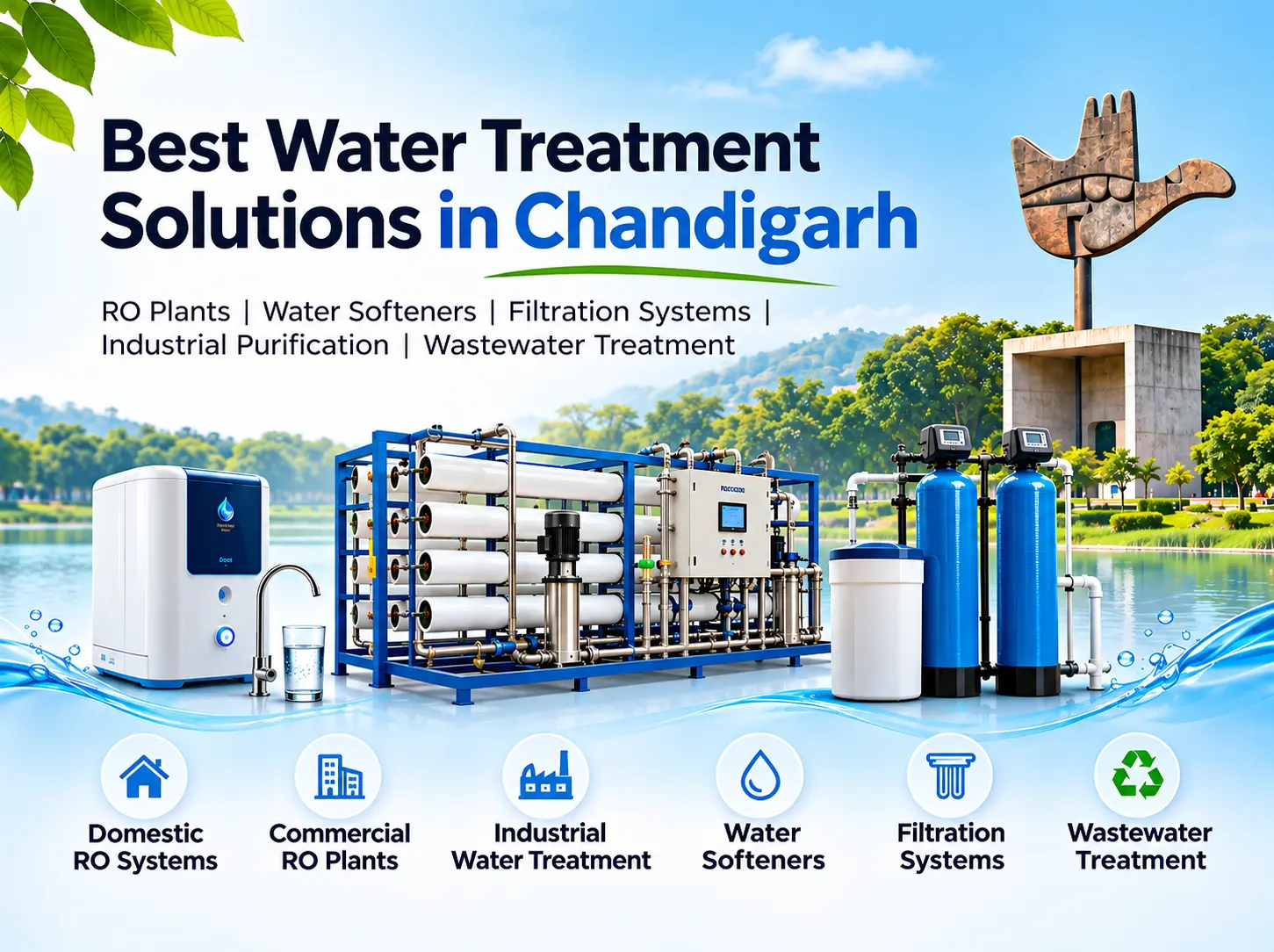
For schools, healthcare facilities, commercial complexes, and industrial plants across Chandigarh, installing engineered commercial and industrial RO plants is non-negotiable. Engineered with high-flux Thin Film Composite (TFC) membranes and multistage vertical centrifugal pumps, our RO plants eliminate up to 99% of dissolved salts, heavy metals, pesticides, and microbial pathogens.
Units range from compact 100 LPH skids for restaurants and boutique clinics to 10,000+ LPH industrial setups with automated PLC-based monitoring and automatic anti-scalant chemical dosing.
2. Automatic Whole-House Water Softeners
For residential bungalows, kothis, and luxury floor apartments, whole-house water softeners treat all incoming water at the overhead tank entry point. Utilizing high-capacity food-grade cation resin beads, the softener exchanges scale-causing calcium and magnesium ions for non-scaling sodium ions.
Modern digital automatic multiport valves automatically execute regeneration cycles based on volumetric water usage, ensuring crystal-clear, lather-friendly soft water for bathing, laundry, and cooking without manual effort.
3. Dual Media Sand & Activated Carbon Filtration
Pre-filtration is vital for raw borewell supplies carrying physical turbidity, silt, and rust flakes. Multi-grade quartz sand vessels filter out suspended particulate matter down to 20 microns. Downstream activated carbon filters with high iodine numbers absorb residual chlorine, volatile organic compounds (VOCs), and foul odors.
Comparison: Raw Water vs. Treated Water in Chandigarh
The following data illustrates the transformation achieved when an engineered RO and softening treatment train is deployed on typical Chandigarh groundwater:
| Water Quality Parameter | Raw Borewell Water (Typical) | After Shivam RO & Softening | Recommended Standard (BIS) |
|---|---|---|---|
| Total Dissolved Solids (TDS) | 650 – 1,100 ppm | 80 – 150 ppm | < 500 ppm |
| Total Hardness (as CaCO₃) | 380 – 620 mg/L | < 30 mg/L (Soft Water) | < 200 mg/L |
| Turbidity (NTU) | 3.5 – 8.0 NTU | < 0.5 NTU | < 1.0 NTU |
| Chloride & Sulfates | High (Elevated scaling risk) | Negligible | Within safe limits |
| Microbial Coliforms | Occasional present | Zero (100% sterile with UV) | Nil / 100ml |
How to Choose the Right Water Treatment System
Selecting an optimal filtration system should always be based on empirical testing rather than guesswork. Here is our recommended step-by-step checklist:
- Conduct Professional Water Testing: Measure exact TDS, pH, hardness, iron, and microbial counts using laboratory-grade digital sensors.
- Assess Daily Volume Requirements: Calculate peak and average daily consumption for your household, commercial workforce, or production lines.
- Identify Pre-Treatment Needs: In borewells with heavy silt, ensure adequate multi-grade sand filtration is installed prior to sensitive RO membranes.
- Inquire About Recovery & Waste Water: High-efficiency commercial RO plants from Shivam Water Treatment offer recovery rates up to 60–75%, minimizing drain discharge.
- Verify Local Service Support: Ensure your equipment is backed by technicians based directly in the Tricity with stock of genuine spare membranes and filter media.
Pro Maintenance Tip
Our technicians provide prompt RO plant repair and membrane cleaning; never run an industrial RO plant without adequate antiscalant chemical dosing or regular micron filter replacement. Replacing a 5-micron pre-filter cartridge every 4–8 weeks protects membranes that cost tens of thousands of rupees.
Frequently Asked Questions (FAQs)
In municipal canal-supplied sectors, TDS generally hovers between 200 and 350 ppm. However, in sectors and outer boundaries relying heavily on deep tubewells, TDS often spikes between 600 and 1,100 ppm, requiring Reverse Osmosis treatment for safe consumption.
No. A water softener removes calcium and magnesium hardness to stop limescale in pipes and appliances, but it does not remove dissolved salts, heavy metals, or bacteria. For drinking purposes, softened water should be processed through an RO purifier.
For an average household of 4–6 family members in Chandigarh, the brine tank typically requires food-grade tablet salt replenishment once every 4 to 6 weeks, depending on the hardness level of your source water.
Yes. Shivam Water Treatment provides complimentary on-site water testing across all sectors of Chandigarh, Mohali, and Panchkula to analyze your TDS and hardness before recommending any equipment.
Conclusion
Clean, pure, and balanced water is essential for your family's vitality and your business's operational continuity. Rather than coping with recurring limescale damage, damaged sanitaryware, or unreliable filtration, partner with certified local water treatment engineers. With over a decade of dedicated service across Chandigarh and the wider Punjab region, Shivam Water Treatment designs, installs, and maintains water treatment systems that deliver peak performance year after year.